← TEAM / DISCIPLINE 02
HAMZA
AI + EDUCATION / AVAILABLE FOR PROJECTS
HAMZA
LUQMAN
AI & Educational Technology Master Graduate
Hamza develops practical AI and educational technology solutions across machine learning, data analytics, web development, robotics and 3D prototyping. His work combines technical implementation with user-focused problem solving, including AI-powered learning tools, data-driven analysis and accessible STEM experiences.
MODEL / OUTPUT
LEARNING EXPERIENCEAI / ML PIPELINEDATA + VALIDATIONUSER PROBLEM
WHAT THE USER FEELS FIRST ↘
CAPABILITIES / 01WHAT HAMZA
WHAT HAMZA
BRINGS.
MSc graduate with Distinction in Artificial Intelligence and Educational Technology, with hands-on experience building AI-powered applications, analysing data and developing technology solutions for educational and real-world use cases.
SKILL SYSTEMBUILD → ANALYSE → PROTOTYPE
SELECTED WORK / FEATURED CASEONE PROJECT.
ONE PROJECT.
FULL SYSTEM STORY.
Hamza's featured work is the AI-Powered English Speaking Practice Tool — an MSc capstone that connects speech recognition, interpretable analytics, deterministic grammar feedback and classroom-friendly script generation in one auditable workflow.
AI-Powered English Speaking Practice Tool
A browser-based speaking practice system for Hong Kong secondary school learners. Users can record or upload speech, receive a transcript, review speaking analytics, run deterministic grammar checking, generate controlled practice scripts and export evidence for later review.
VOICE INPUT / LIVE ANALYSIS READY
TRANSCRIPT STREAM
Speak naturally. The system listens, transcribes, analyses pace and fillers, then prepares structured feedback.
READ FULL CASE STUDYArchitecture, interface, engineering decisions, validation & screenshots+
01 / WHY IT EXISTS
Low-pressure speaking practice with feedback learners can actually inspect.
The project addresses a practical gap: secondary learners need more opportunities to practise oral English, while classroom time and teacher capacity limit repeated individual feedback. Instead of treating AI as a single black-box score, the prototype makes each stage visible — transcript, pace, fillers, intonation indicators, grammar corrections and exportable evidence.
02 / SYSTEM DESIGN
A transparent two-tier architecture.
The frontend is browser-based and connects to a FastAPI backend. Core modules handle faster-whisper speech-to-text, speech analytics, deterministic LanguageTool grammar checking, controlled script generation and result export. The workflow was designed to be repeatable and technically auditable.
- Record or upload audio
- Transcribe with faster-whisper
- Calculate WPM, fillers and intonation statistics
- Run deterministic grammar feedback
- Generate constrained speaking scripts
- Export JSON/TXT evidence artifacts
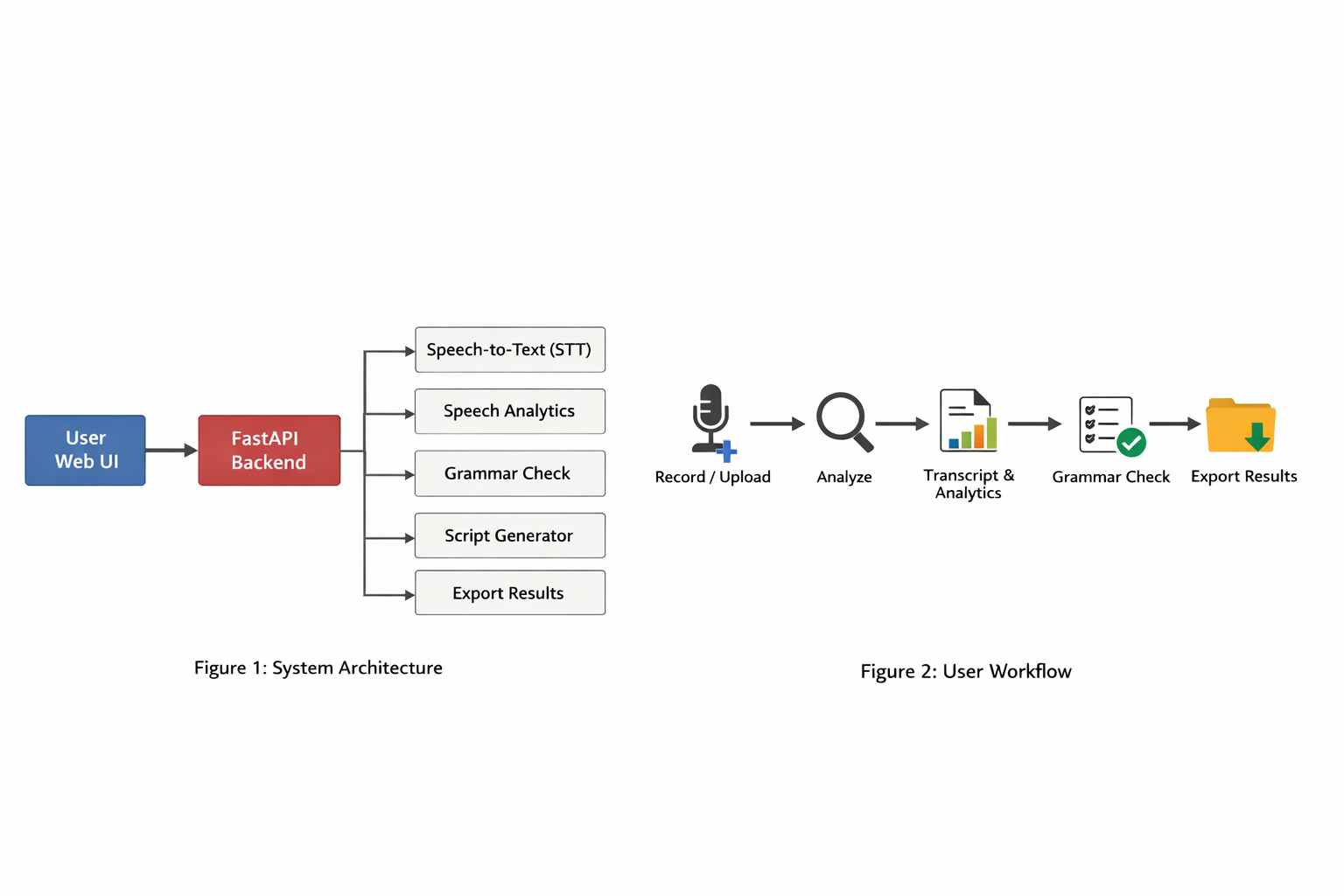 SYSTEM ARCHITECTURE + USER WORKFLOW ↗
03 / PROTOTYPE INTERFACE
Analysis on the left. Script generation on the right.
The working interface separates the core speaking-analysis workflow from optional script generation. Learners can record or upload audio, inspect transcript and analytics, run grammar checks and export evidence without leaving the page.
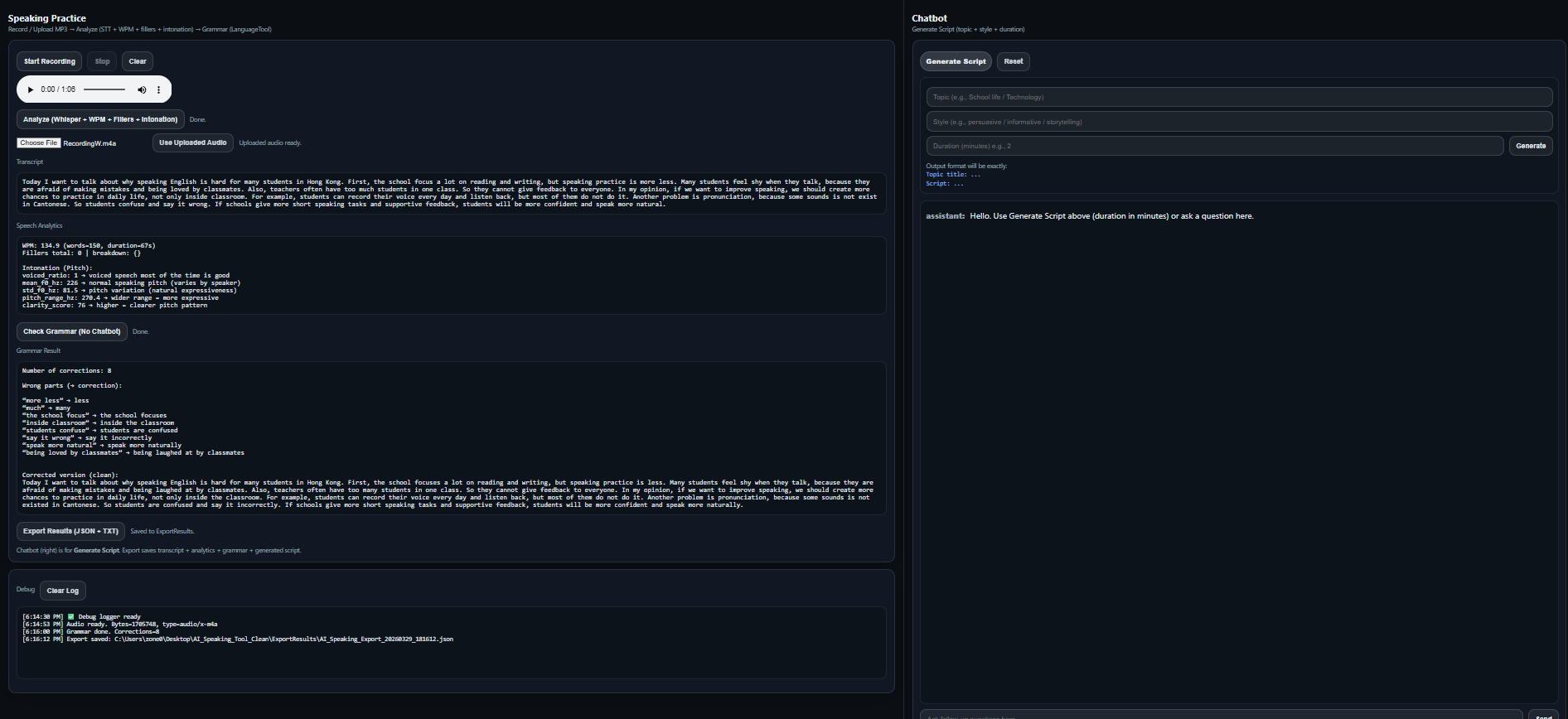 ACTUAL UI SCREENSHOT · OPEN FULL SIZE ↗
04 / TECHNICAL VALIDATION
Measured instead of merely demonstrated.
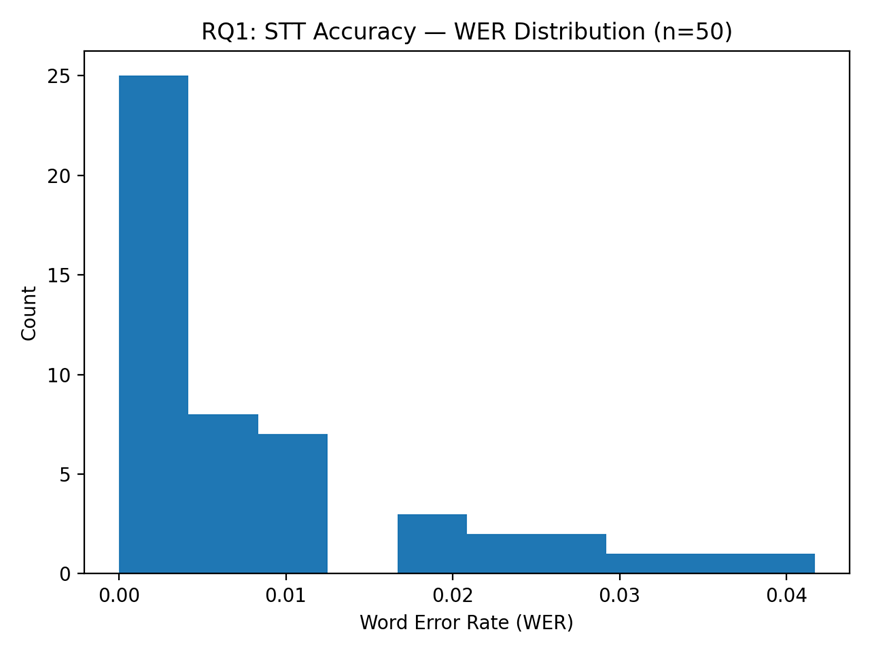
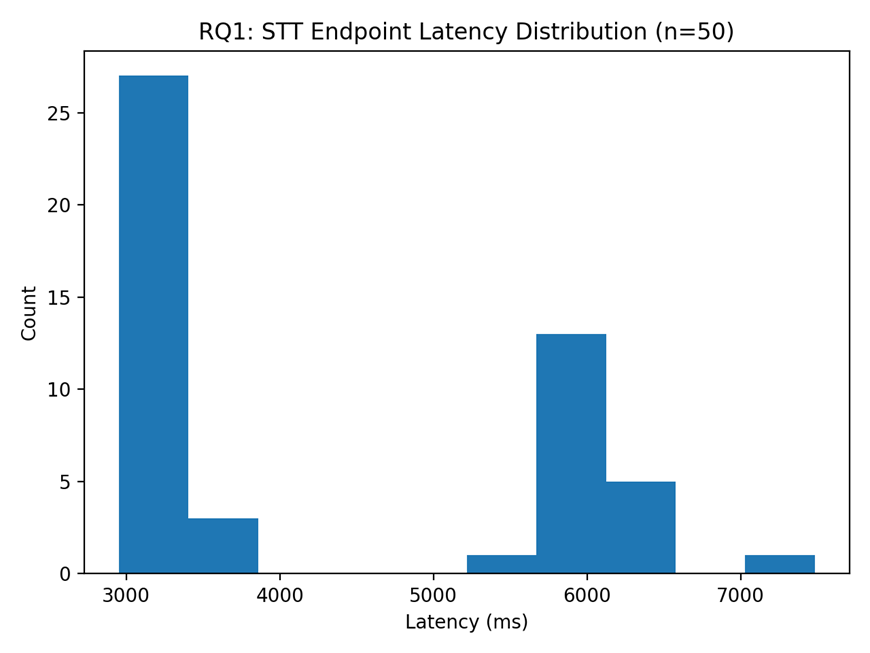
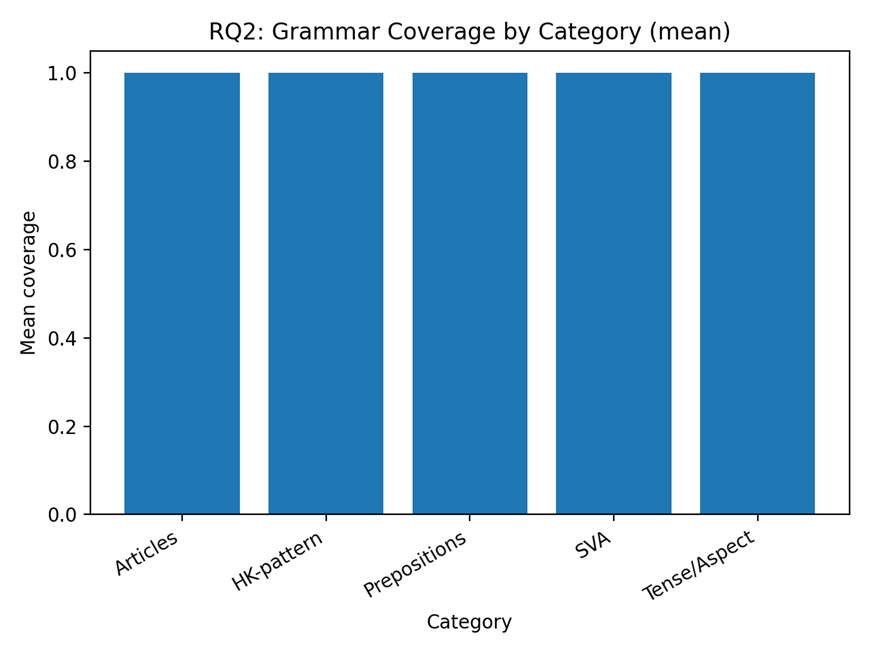
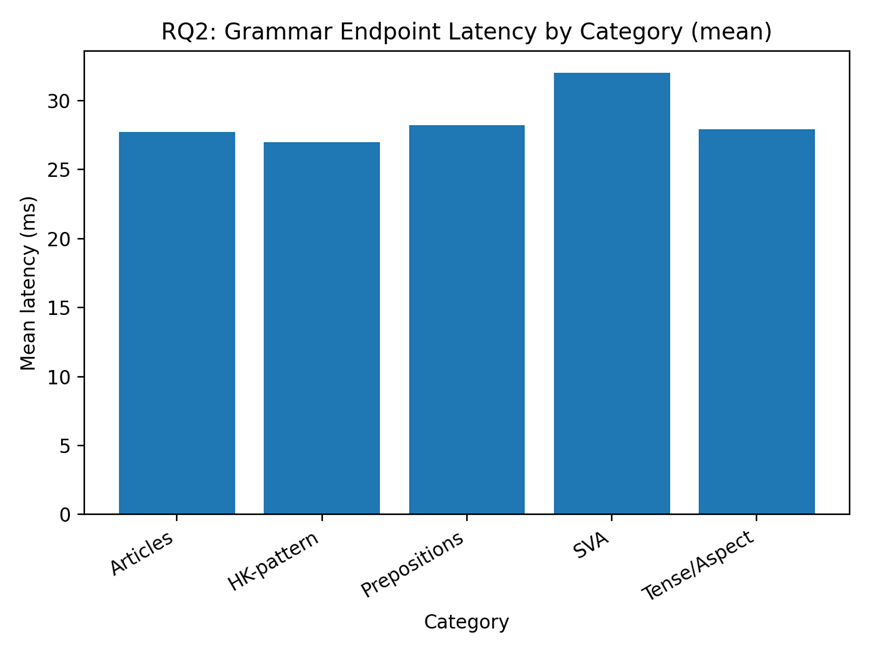
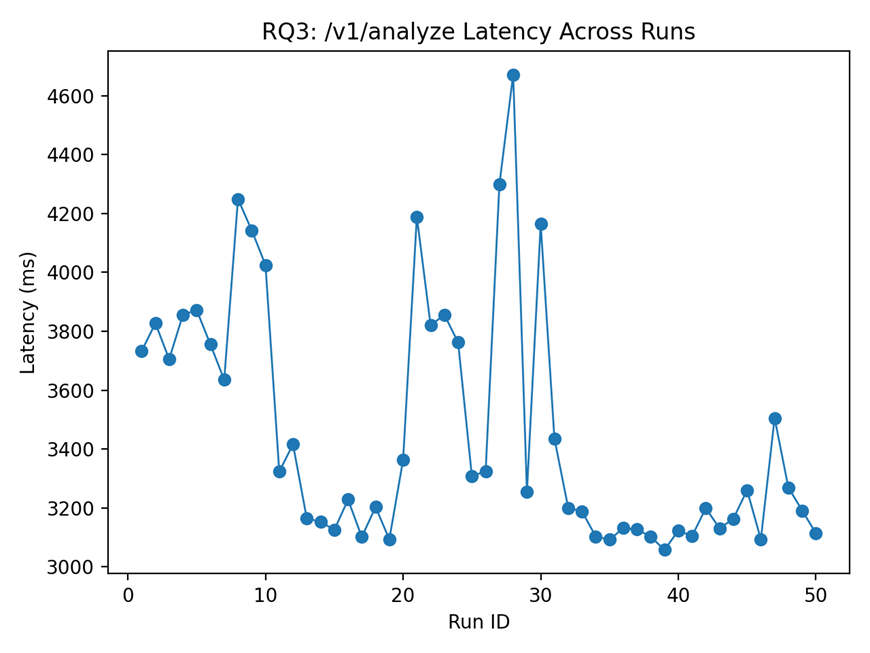
The capstone uses reproducible technical validation rather than making unsupported classroom learning-outcome claims. Speech recognition was tested with 50 controlled recordings; grammar checking used a 50-item suite across five categories; repeated endpoint runs tested stability.
05 / EVIDENCE & RELIABILITY
Traceable outputs, stable endpoints.
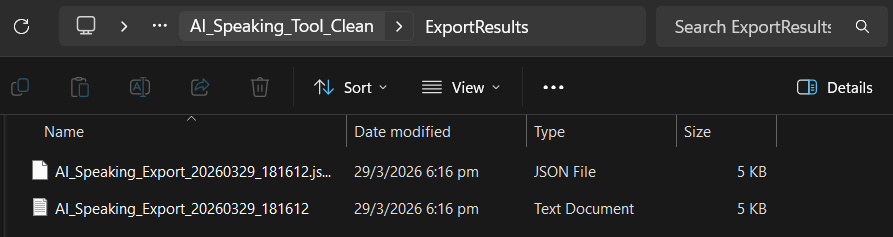
Results can be exported as evidence artifacts for reporting and auditing. Repeated-run testing recorded 50 successful calls for both the analysis and grammar endpoints with no observed failures in the recorded trials.
Grammar correction was moved to a deterministic endpoint so repeated inputs produce consistent, testable outputs instead of relying on uncontrolled generative responses.
faster-whisper supports local transcription. The prototype also uses a fixed project-relative ffmpeg path to reduce environment dependency during validation.
Analysis, grammar results and metadata can be stored as JSON/TXT artifacts, making the system easier to inspect, demonstrate and audit.
The architecture leaves room for spontaneous-speech validation, richer prosody analysis, expanded grammar suites, teacher dashboards and longitudinal database storage.
MORE TECHNICAL WORKFROM MODELS
FROM MODELS
TO PHYSICAL SYSTEMS.
MNIST-based educational deep-learning study with a proposed human-in-the-loop grading workflow; approximately 99.0% validation accuracy reported in the project.
Team prototype combining a 3D-printed arm, AI face recognition, Huskylens sensing and micro:bit control for recognition-driven manipulation.
Business proposal exploring AI analysis of sleep-pattern data, wearable inputs and personalised Q&A guidance.
EDUCATIONAI + EDUCATIONAL
AI + EDUCATIONAL
TECHNOLOGY.
The Education University of Hong Kong · Distinction
The Education University of Hong Kong
LANGUAGESCOMMUNICATE / BUILD / DELIVER
EnglishNative or Bilingual
CantoneseNative or Bilingual
ChineseNative or Bilingual
UrduNative or Bilingual
Panjabi / PunjabiFluent
PROJECT INTAKE / 24-7Want Hamza on an AI or EdTech project?Direct email · luqmanhamza710@gmail.com
Contact Hamza ↗